

by David Hagenbuch - professor of marketing at Messiah University -
author of Honorable Influence - founder of Mindful Marketing
author of Honorable Influence - founder of Mindful Marketing
How far are you willing to go for fun? For some, it’s battling the traffic and crowds at busy summer beaches. For others, it’s climbing over ice and fighting to breathe on an expedition up Everest. Depending on one’s taste and budget, either one of these experiences can be a great time, but as extreme tourism increases, it’s time to ask, are extraordinary leisure activities worth their costs?
By now, most have heard of the Titan submersible’s ill-fated excursion to explore the sunken Titanic. When I first learned that OceanGate’s record-setting sub went missing enroute to the wreckage that lies 2.37 miles below the surface of the North Atlantic, I assumed it was a scientific expedition. Only after additional news reports did I realize that the five passengers passed away on a pleasure trip.
Regardless of the reason for the voyage, it’s tragic that these individuals lost their lives. It’s frightening to think of a sub imploding; hopefully, their passing was quick and painless. Still, the nature of the trip has caused some to question whether such a tour should have been offered, given its inherent risk.
Many people have jobs that require them to risk their lives each day such as: first responders, miners, loggers, construction workers, oil and gas workers, electrical power line installers and repairers. These brave individuals are typically well-trained and well-aware of the danger in their work, which they do to serve others, as well as for income. Leisure activities, in contrast, are by definition discretionary.
While everyone should have recreational time in which they can refresh their body and mind, there are many things people can do that require minimal cost and pose little or no risk, from reading, to walking in a park, to playing pickle ball. So, why does anyone need to do extremely dangerous activities like:
Of course, everyone is wired differently in terms of the recreational activities that bring them pleasure. While some like low-key, passive leisure (e.g., watching movies), others enjoy the physical exertion and competition that comes from playing a sport (e.g., tennis, football). Still others crave much more, like:
Before becoming vice president for finance and administration at Martin’s Famous Potato Rolls and Bread 12 years ago, Scott Heintzelman had a successful two-decade career in public accounting, including a long tenure as a CPA firm partner. For many people in his position and stage of life, the most leisure energy they’d expend would be on a round of golf. However, just before the age of 50, Heintzelman ran his first marathon, then soon turned his attention to triathlons. Over the past five years he's completed 13 Ironman races.
Heintzelman’s friends, family members, and others sometimes say he’s crazy to needlessly put himself through the months of grueling training followed by the body-breaking 140.6-mile competitions, which culminate with him crying upon crossing the finish line. So, why does he choose to recreate in such an extreme way?
By now, most have heard of the Titan submersible’s ill-fated excursion to explore the sunken Titanic. When I first learned that OceanGate’s record-setting sub went missing enroute to the wreckage that lies 2.37 miles below the surface of the North Atlantic, I assumed it was a scientific expedition. Only after additional news reports did I realize that the five passengers passed away on a pleasure trip.
Regardless of the reason for the voyage, it’s tragic that these individuals lost their lives. It’s frightening to think of a sub imploding; hopefully, their passing was quick and painless. Still, the nature of the trip has caused some to question whether such a tour should have been offered, given its inherent risk.
Many people have jobs that require them to risk their lives each day such as: first responders, miners, loggers, construction workers, oil and gas workers, electrical power line installers and repairers. These brave individuals are typically well-trained and well-aware of the danger in their work, which they do to serve others, as well as for income. Leisure activities, in contrast, are by definition discretionary.
While everyone should have recreational time in which they can refresh their body and mind, there are many things people can do that require minimal cost and pose little or no risk, from reading, to walking in a park, to playing pickle ball. So, why does anyone need to do extremely dangerous activities like:
- Free climbing – climbing a rock face with no ropes
- Base jumping – parachuting from a fixed structure
- Bull running – jogging with horned bovines
- Big wave surfing – boarding on swells that reach 50 ft. or more
Of course, everyone is wired differently in terms of the recreational activities that bring them pleasure. While some like low-key, passive leisure (e.g., watching movies), others enjoy the physical exertion and competition that comes from playing a sport (e.g., tennis, football). Still others crave much more, like:
- Experiencing an extreme adrenalin rush
- Seeing or doing something that few others have seen or done
- Testing one’s physical and mental limits
Before becoming vice president for finance and administration at Martin’s Famous Potato Rolls and Bread 12 years ago, Scott Heintzelman had a successful two-decade career in public accounting, including a long tenure as a CPA firm partner. For many people in his position and stage of life, the most leisure energy they’d expend would be on a round of golf. However, just before the age of 50, Heintzelman ran his first marathon, then soon turned his attention to triathlons. Over the past five years he's completed 13 Ironman races.
Heintzelman’s friends, family members, and others sometimes say he’s crazy to needlessly put himself through the months of grueling training followed by the body-breaking 140.6-mile competitions, which culminate with him crying upon crossing the finish line. So, why does he choose to recreate in such an extreme way?

Heintzelman says he likes testing himself mentally and physically and adds that enduring pain, delaying gratification, and overcoming negative thoughts have helped him become more disciplined, focused, and resilient – qualities that serve him well in other areas of life.
As the preceding suggests, participating in an Ironman certainly comes with physical costs. It also comes with some significant financial ones such as $1,000-$5,000 for a race-quality bike, $800 for travel expenses, $150 for a 6-month gym membership, and a $600-$800 race entry fee.
Still, these costs pale in comparison to an ultra-extreme sport like high-altitude mountain climbing, for which participants pay “around $100,000 or even more for the privilege to get to the world’s highest peaks.” In the process, there’s real risk of life altering injuries and death from falls, extreme cold, and oxygen deprivation, where above 8,000 meters, “there is so little oxygen that the body starts to die, minute by minute and cell by cell.”
This year, 12 climbers have died on Mount Everest, the world’s highest peak, and regrettably, five more who are missing and likely dead will make 2023 “the deadliest year ever.” One of the reasons for the increase in fatalities is overcrowding, as more inexperienced guides and climbers have made for a record number of climbing permits and caused traffic jams on already very challenging slopes. At times, queues of climbers enroute to the summit have looked like lines of vacationers waiting for a popular Disney World ride.
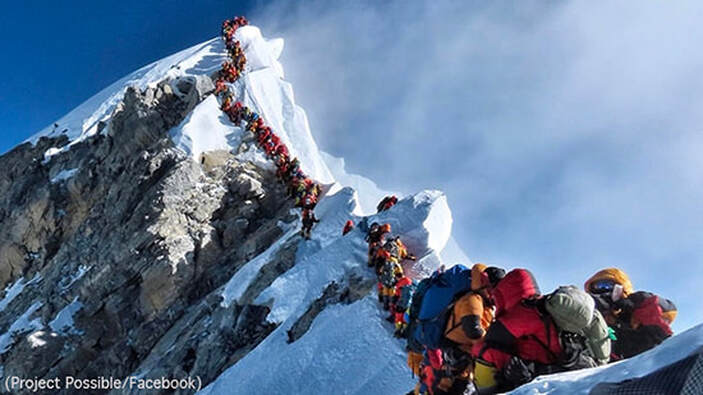
There are reportedly more than 50 companies that offer guided tours on Everest. Great supply is usually good for consumers, as added competition typically means more options and lower prices. Those things are true to some extent for Everest, but they’ve also meant a dangerous lowering of standards for climber competence and safety, to the point that certain companies will “take absolutely anyone up the mountain, regardless of experience, and cut corners on safety standards.”
One company that’s particularly notorious for taking human life lightly is Seven Summit Treks. Unlike other firms that usually limit their expeditions to 20 people, Seven Summit “is known to take as many as 100 climbers up the mountain — many of whom are unprepared for the altitude and physical exertion.”
The company also offers a VIP Everest Expedition “designed for those seeking to summit Mt. Everest in the utmost comfort and convenience” whether they are “an experienced climber or a first-timer for 8000er.” The expedition includes lessons at Everest basecamp on “ice wall climbing, ladder crossing, and other techniques that will be required for the ascent” – skills you’d think anyone who hopes to climb the world’s highest mountain would have already mastered.
This piece has gone from the depths of the sea with the recent OceanGate tourism tragedy to the heights of the earth with lives lost seeking to summit Everest. So, what do these two elevation extremes and all the options in between mean for those providing extreme leisure activities? Here are three potentially helpful considerations:
1) It’s hard to judge what leisure is too costly and risky: I would generally describe myself as cost-conscious and risk-adverse, which makes me want to point my finger at others spending hundreds of thousands of dollars and risking their lives to do things like deep ocean exploring and high-altitude climbing. Then I remember that I’ve done some leisure activities that others might consider too expensive and risky.
More than a decade ago, when my wife and I visited Kauai, we took advantage of what seemed like a once-in-a-lifetime opportunity: to view the breath-taking island by helicopter. The nearly $200 we spent per ticket certainly could be considered excessive for the 50-minute ride. Likewise, flying inside canyons on the rugged Napali coast had risk. Then again, anyone who flies or drives anywhere for a vacation could be accused of incurring unnecessary cost and risk.
The point is, it’s difficult to draw a clear line between what is and isn’t excessive leisure. That’s not to say that there shouldn’t be a line or that anything should go but rather that it might be helpful to consider factors like cost relative to the individual’s income, if not per capita income, as well as the percentage of instances of severe injuries or death for those who engage in the activity.
2) Leisure interest can lead to scientific discovery: Sometimes people’s leisure leads to discoveries that benefit much larger groups of people. For instance, amateurs have documented unique animal behaviors and even discovered new species.
People pursing their recreational passions also have played significant roles in advancing fields like avionics and computing. Most recently, companies including SpaceX are leveraging what they’re learning from offering space tourism to create the potential for dramatically faster point-to-point travel on earth, such as a flight from New York City to Shanghai that might only take 40 minutes.
3) Consumers’ safety is critical: Ultimately, what matters most for companies marketing recreation of any kind, including extreme tourism, is safety. Of course, before people participate in dangerous activities, organizations must clearly communicate the risks. It’s fine to ask participants to sign waivers; however, those releases should never become substitutes for taking every reasonable step to ensure that individuals simply looking for a pleasurable leisure experience don’t return injured or dead.
It seems that the two extreme tourism companies mentioned above have both fallen short of this critical standard. Since OceanGate’s Titan submersible exploded, many have reported that there were serious safety concerns surrounding the structural integrity of the deep-diving craft. Similarly, beyond Seven Summits Treks’ questionable onboarding practices described above, the firm’s owner resists rules for who should or shouldn’t enter into Everest’s death zone; instead, he recommends, “If [people] have enough energy, they can go.”
As Baby Boomers and Gen Xs look for a last hurrah and experience-driven Gen Ys and Zs gain disposable income, it’s likely that demand for extreme tourism will continue to increase. Companies that want to capitalize on this trend should ensure that the benefits they provide to clients are proportionate to the costs they incur. In addition, others outside the exchange shouldn't be asked to bear costs (e.g., environmental degradation, rescue costs) without receiving benefits.
Above all, organizations must do everything possible to ensure their clients’ safety. In an often-unpredictable natural world complicated by periodic human error, safety can seldom be guaranteed. However, at 3,800 meters below sea level or 29,000 meters above it, companies should have air-tight models for returning their clients safely; otherwise, they’re liable for “Single-Minded Marketing.”

Subscribe to Mindful Matters blog.
Learn more about the Mindful Matrix.
Check out Mindful Marketing Ads and Vote your Mind!
Learn more about the Mindful Matrix.
Check out Mindful Marketing Ads and Vote your Mind!
 RSS Feed