

by David Hagenbuch - professor of marketing at Messiah University -
author of Honorable Influence - founder of Mindful Marketing -
author of Mindful Marketing: Business Ethics that Stick
author of Honorable Influence - founder of Mindful Marketing -
author of Mindful Marketing: Business Ethics that Stick
It’s hard to rationalize writing about certain topics that you don’t want to dignify with attention. Sydney Sweeney’s skin-baring ad for the sports betting firm Novig embodies that tension. If the ad were only in one way degenerate, it might be best to let it slide into obscurity, but its dual depravity demands an indictment.
Sweeney is known for her acting roles in series such as Euphoria and The White Lotus, as well as serving as the spokesperson for another controversial ad campaign: American Eagle’s “Great Jeans.” While AE's ads were contentious because of sensitive wordplay, Sweeney’s spot for Novig is far less sophisticated.
The ad for the all-sports prediction market company leaves little of Sweeney to the imagination. In a combination of clips evocative of ‘ESPN meets Playboy,’ the actress strikes many highly suggestive poses, covering private parts of her otherwise nude body with footballs, hockey gloves, shoulder pads, etc. It’s ironic that a spokesperson in a sports-related ad wears no uniform.
I won’t provide a link for the ad because I don’t recommend watching it, but you can find it through search if you feel you need to see it. My reticence suggests the first and most obvious reason for censuring the spot – it’s extreme sexual explicitness. I’m no expert, but it’s hard to imagine what would differentiate it from pornography.
One might wonder, “If the spot is so salacious, why would regulators allow it to air? Surely federal law should censor it.”
If shown on broadcast media, i.e., network or cable television, the ad would be subject to Federal Communication Commission (FCC) regulations such as, “Indecent and profane content are prohibited on broadcast TV and radio between 6 a.m. and 10 p.m., when there is a reasonable risk that children may be in the audience.”
The ad apparently has averted such rules through digital-only distribution. A patchwork of loosely enforced laws, like age verification on certain websites and the ability of digital platforms to regulate their own content make it relatively easy for sexually explicit content to exist online.
Those are some of the reasons why Novig’s Sweeney ad is available, but what makes it unseemly? Over millennia, there has been great diversity of opinion about what constitutes indecency, including sexual impropriety, ranging from public acceptance of prostitution in ancient Rome to Puritans’ repudiation of sex outside of marriage.

Such diverging perspectives about sex-related communication exist within singular societies today, as evidenced by some who have applauded Novig’s ad for celebrating the beauty of women while others suggest that the same spot objectifies them.
Because such disparity exists about which moral principles are relevant to sexual explicitness, it may be helpful to consider possible consequences of Novig’s ad. The following are four potential outcomes:
1. Greater appreciation of women’s beauty: Because some claim this benefit, it would be disingenuous to dismiss it. However, in projecting the possible outcome, we also should consider the main target market for sports betting, young men, and ask: To what extent do most of them not already believe women are beautiful?
For young men, that recognition tends to be hardwired, i.e., nothing needs to convince them of feminine attractiveness. What likely would be useful is to help the target market see women as whole people, beautiful beyond specific body parts, and not simply as objects of sexual desire – a suggestion that leads to the next outcome.
2. Seeing women as sexual objects: It’s natural for adults to want to be seen as attractive and, in many cases, sexually attractive. Such beliefs about oneself can support positive self-esteem and be part of healthy, reciprocal relationships. However, the extreme sexual suggestiveness of the Sweeney ad likely stimulates many more carnal cravings than it encourages mutual respect and admiration.
After the 2020 Super Bowl halftime show with pole-dancing Jennifer Lopez and Shakira, I wrote an article asking if the Federal Communications Commission should have allowed the sexually suggestive performance. In the show’s aftermath, some cheered women’s empowerment while others argued objectification. I agreed with the latter, citing several instances when cameras zeroed in on specific body parts of the performers, effectively disaggregating their personhood.

Novig’s ad features similar shots of Sweeney, who sports even less clothing. While the money high-paid product spokespeople make may empower them, over-sexualized views of women’s bodies harm countless other women and girls, such as former Yale University student Veronica Lira Ortiz who has described her experience as a child in a Latin culture infused with machismo:
“I was twelve years old, and a man on the street [in Mexico] was already verbally harassing me. He looked at me as if I were a juicy steak instead of an innocent child.”
3. Increased sexual violence: Will a man view Novig’s ad then start to sexually abuse women? Probably not. Still, the spot perpetuates pejorative views of women, which when combined with similar mass media messages can incline some men toward sexual violence.
UNICEF maintains that “The objectification and sexualization of girls in the media is linked to violence against women and girls worldwide.” Research by the American Psychological Association supports a similar claim that widespread sexualization of women leads to interpersonal harm.
4. Greater Pornography Addiction: Per the last point, men harm women indirectly when they objectify them and directly when the objectification turns into to sexual abuse. Men also hurt themselves and their loved ones when they become obsessed with sexually explicit visual and verbal content.
It’s likely that more 10% of American men have a pornography addiction: a self-injurious obsession that can lead to many other negative outcomes including mental health issues, poor work performance, and fractured relationships. Of course, one view of a sexually explicit ad doesn’t constitute an addiction, but it stands to reason that every preoccupation begins with an initial exposure, and the more a first view beckons for a second, the more likely addiction with ensue.
Outcomes 2-4 above are damaging by themselves, but what makes Novig’s ad doubly destructive is the product it promotes: prediction markets.
Six months ago, I wrote an article about these betting exchanges that circumvent states’ gambling laws by matching opposing wagerers rather than a “house” taking bets and paying winners.

For some, gambling is a pastime like scrapbooking and hiking that they do for fun and that they can stop anytime. However, for a significant number of others, betting is an addiction they can’t control that threatens their health, hurts relationships, and can easily lead to financial distress.
What makes prediction markets like Kalshi and Polymarket more ruinous than regular gambling are looser regulations and the ability to bet on anything, from Which politicians will win primary elections to Will Taylor Swift be pregnant by year-end?
On one hand, Novig is less detrimental than its ‘full-service’ competitors in that it only offers sports betting. However, as suggested earlier and as research from Farleigh Dickinson University supports, sports gambling is what snares young men most.
In sum: Novig’s ad with a nearly nude Sydney Sweeney tempts a young male target market with two of its most enticing vices: pornography and sports gambling – a perfect storm of addiction.
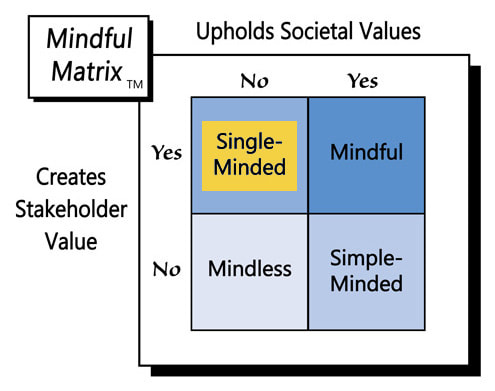
Leading anyone into addictive behavior is a bad thing. Encouraging an entire demographic to fall into not just one but two types of addiction is unconscionable, as well as an extreme example of Single-Minded Marketing.
Subscribe to Mindful Matters blog.
Learn more about the Mindful Matrix.
Check out the book, Mindful Marketing: Business Ethics that Stick
Learn more about the Mindful Matrix.
Check out the book, Mindful Marketing: Business Ethics that Stick
 RSS Feed